Field Team Productivity
Digital job sheets and routing tools can reduce repeated entry, shorten handoffs, and give field teams more time for the work that requires their attention. Improvement is measured against the client’s current process.
Mobile app development by PhaneLabs
Give customers a faster way to buy, book, track, or ask for help. Give field teams secure access to the information and actions they need away from a desk, even when connectivity is unreliable.
PhaneLabs designs and develops iOS and Android applications, connects them to your existing systems, and plans for release and support. Native or cross-platform technology is chosen after the user and business requirements are clear.
Design for use in the real world
These editorial photographs illustrate mobile product design and collaborative testing. They are not PhaneLabs team photographs, client applications, or evidence of app-store performance.
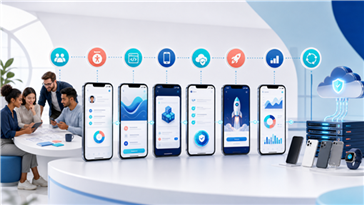
Every release is shaped by hands-on device review, practical usability testing, privacy-conscious feedback, and a clearly documented decision trail.
What it means
Mobile application development for B2B environments is fundamentally different from building consumer-facing apps. Consumer products often emphasize engagement, while enterprise mobile apps must also account for operational efficiency, systems integration, device management, and the security requirements of the data they handle.
It is the process of translating complex, multi-layered enterprise workflows, like logistics tracking, factory floor asset management, or field sales CRM updates, into a streamlined, touch-first interface. This requires sophisticated mobile architectures capable of linking directly to your legacy ERP databases, executing bounded automation, and presenting approved operational analytics on managed mobile devices.
Whether your team is tracking supply chain metrics in a warehouse or closing high-value contracts on the road, custom mobile app development can shape your digital infrastructure around the tasks, devices, and constraints of work in motion.
Why enterprises choose it
Generic SaaS mobile tools can be a fast, economical choice when their workflows fit. When they do not, teams may face integration gaps, duplicated data, or unnecessary steps because packaged products are designed for a broad market rather than one operating model.
Custom mobile app development provides your business with a proprietary operational asset. Instead of forcing technicians to navigate clunky interfaces that don't match their daily routines, a bespoke mobile app can streamline the priority tasks identified in discovery. Depending on scope, it may reduce double entry, route approvals, and present role-appropriate KPI views away from a desk.
By owning the mobile codebase, your business dictates the product roadmap. You are free from arbitrary per-user licensing fees and sudden vendor price hikes. You gain the power to integrate proprietary AI features, scale across new geographic divisions seamlessly, and build an operational moat that your competitors cannot simply purchase off the shelf.
Why it matters
A strategically engineered enterprise mobile app instantly collapses communication delays and accelerates decision-making across all levels of your organization. When your core software is instantly accessible via smartphone or tablet, administrative overhead drops dramatically.
Digital job sheets and routing tools can reduce repeated entry, shorten handoffs, and give field teams more time for the work that requires their attention. Improvement is measured against the client’s current process.
Executive dashboards replace delayed weekly reports. Management spots supply chain bottlenecks and financial discrepancies instantly through automated push notifications.
By automating routine data collection, integrating device cameras for instant barcode scanning, and utilizing GPS for precise logistics tracking, your workforce spends time executing tasks rather than managing administration.
Built around your reality
Premium mobile app development requires a deep understanding of physical environments. Before selecting a tech stack, we study where and how your application will be used. Will field workers be wearing gloves? Will they be in remote warehouse zones with zero cellular reception? Will executives need one-thumb navigation for rapid approvals between meetings?
We do not build from theoretical mockups. We analyze the real-world friction points of your mobile workforce. By focusing aggressively on practical B2B solutions, like optimizing battery consumption for long shifts, testing offline data behavior, and simplifying the user onboarding journey, we give the product a stronger basis for adoption and measure the result with agreed user evidence.
We audit your legacy API connections, define explicit role-based access controls, and map the priority user journeys. The interface is then tested to reduce redundant screens and surface the information each role needs at the relevant step.
Quick links
These links point to the main web app development areas on this page so visitors can quickly scan the direction that best fits their goals.
Our delivery model
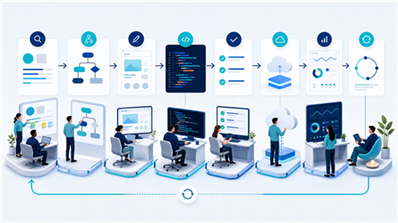
We use an iterative mobile development process designed to surface risk and validate business logic early. The agreed delivery cadence includes demonstrations and test builds so stakeholders can inspect working behavior before final deployment.
We clarify your high-level business objectives, audit your existing backend databases, define strict security requirements, and establish the structural project roadmap.
We design touch-optimized wireframes, model the offline-sync logic, and select the optimal framework (Native vs. Cross-Platform) based on your performance targets.
We write modular, high-performance code in short cycles. You receive secure, playable test builds directly on your devices via TestFlight or Google Play Console to approve functionality in real-time.
We manage the complex App Store and Google Play submission processes, configure crash analytics, and monitor the release so issues can be identified and handled quickly.
How engagement works
Corporate stakeholders need agreed visibility into progress, budget use, decisions, and technical risks. We structure the engagement so your leadership retains decision authority while our team contributes mobile product and architecture support within the contracted scope.
We define the Minimum Viable Product (MVP) around the highest-value assumptions, creating an earlier opportunity to test demand, usability, technical risk, and the path to measurable value.
We replace vague status emails with live demonstrations. Your team tests interactive features, validates biometric login flows, and confirms backend API speeds directly within the staging environment.
Mobile operating systems and store policies continue to change. Where ongoing support is included, the maintenance plan can cover patch review, dependency upgrades, compatibility testing, and agreed usage evidence for later roadmap decisions.
Trust and outcomes
We identify data, device, identity, and network risks before selecting controls. SAML integration, certificate pinning, and at-rest encryption are examples, not universal defaults. Applicable compliance obligations and validation evidence are defined with the client's qualified legal and security advisors.
Flutter or React Native can reduce duplicated implementation when iOS and Android share workflows. We compare that potential saving with native performance, hardware access, accessibility, testing, and platform-specific maintenance needs before recommending it.
Where offline work is required, local storage and conflict-aware synchronization can help staff continue approved tasks when the network drops. The expected offline duration, data sensitivity, and conflict rules are tested for the actual operating context.
Scope
Enterprise mobile application development goes far beyond writing interface code. It is the orchestration of a complete digital ecosystem. It encompasses deep user research, platform-specific UI/UX design (adhering strictly to Apple Human Interface Guidelines and Google Material Design), robust backend API creation, and the configuration of Mobile Backend-as-a-Service (BaaS) architectures.
A comprehensive mobile project demands rigorous automated QA testing across dozens of physical device configurations to ensure layout stability and battery efficiency. It includes establishing Continuous Integration/Continuous Deployment (CI/CD) pipelines specifically tuned for mobile binaries, allowing for rapid over-the-air updates. Ultimately, it is about engineering a secure, high-speed conduit between your centralized corporate data and the mobile devices powering your frontline workforce.
Compare
An important architectural decision is choosing how to build the application.
Native Development (Swift for iOS, Kotlin for Android): This approach involves writing two completely separate codebases. It is the gold standard for applications requiring maximum computational performance, intense graphical processing, or deep hardware integration (like complex Bluetooth or advanced camera controls). However, it requires maintaining two separate engineering teams, significantly increasing initial budgets and ongoing maintenance costs.
Cross-Platform Development (Flutter, React Native): This modern approach utilizes a single codebase to deploy high-performance applications to both iOS and Android simultaneously. For the vast majority of B2B enterprise applications, such as ERP dashboards, CRM tools, and field logistics apps, cross-platform frameworks can reduce duplicated implementation and make feature consistency easier to manage. The choice still depends on hardware access, performance needs, team skills, and the long-term product roadmap.
PhaneLabs analyzes your exact feature requirements to recommend the exact stack that maximizes performance while protecting your budget.
Kinds
We architect specific mobile structures to solve distinct operational challenges:
Each type brings different non-functional needs: performance and scalability for commerce, auditability and validation for regulated domains, and flexible data modeling for enterprise reporting. When planning custom software development, select patterns and tools suited to the problem category rather than a one-size-fits-all architecture.
Focused mobile service
This focused page addresses Android-specific product decisions while this service hub remains the broader guide for mobile app development.
Where it applies
A well-scoped mobile app can support important workflows across several sectors:
Cross-department value
Fragmented communications create costly delays. Custom mobile apps solve this by acting as a unified, pocket-sized integration layer, pulling critical data from disparate departments into a single, cohesive interface.
Measurable outcomes typically include lower operational costs, fewer manual errors, faster customer response times, and clearer management reporting, all outcomes that justify investment in mobile app development.
Advantages
Investing in bespoke mobile app development directly influences enterprise scalability and market positioning:
Because the platform is built for your business, teams spend less time on manual work and more time on high-value activities. That shift improves productivity and can increase revenue while lowering avoidable costs.
How we build
Building high-performance mobile software that survives the chaos of field operations demands strict engineering discipline:
Good custom mobile app development emphasizes early validation (PoCs/MVPs), measurable milestones, and a plan for long-term operations so the product remains sustainable.
Planning
To avoid expensive mid-development pivots, we define several strategic variables immediately:
Pitfalls
We actively steer our B2B clients away from the most damaging mobility pitfalls:
Standards
We select coding and operational practices according to the product's scale, device conditions, risk, and agreed acceptance criteria:
Selecting a partner
Mobile engineering requires specialized expertise. When selecting a B2B partner, look for these defining traits:
Why PhaneLabs
PhaneLabs starts with the B2B operating context: who is using the product, on which devices, under what network conditions, and for which measurable task. Architecture, security controls, and release decisions follow those requirements rather than generic promises.
A proposed fleet tool, customer portal, or financial dashboard is scoped around its integrations, data risk, device estate, and support owner. We provide reviewable architecture decisions, agreed repository access, test evidence, and a release plan matched to that environment.
FAQ
Cross-platform frameworks such as Flutter or React Native can be a strong fit when both platforms share the same workflows. Native development may be better for deep hardware integration or highly platform-specific experiences. We compare those tradeoffs against the product requirements before recommending a path.
When offline work is in scope, we define which actions remain available, what data may be stored locally, and how conflicts are reviewed after reconnection. Encryption, retention, authentication, and synchronization behavior are selected and tested against the approved device and data-risk model.
Depending on platform eligibility and the client's accounts, private distribution can use Apple Business Manager, Managed Google Play, or an existing Mobile Device Management solution. Distribution restrictions support access governance but still need identity, device, revocation, and monitoring controls.
Share your goals, constraints, and timeline. We will help you build a mobile app development roadmap that is realistic, scalable, and built for measurable business impact.
Talk to Our TeamExplore more
Mobile application services
Compare platform choices, business use cases, and delivery questions before deciding what belongs in the first release and how the product will be supported.
12 focused guidesCompare platform-specific and multi-platform approaches around the people, devices, and environments you need to support.
Explore mobile products shaped by customer access, commerce, or connected business workflows.
Use these guides to prepare the product, delivery model, and decisions that reduce avoidable rework.